




November 10, 2020
How to Convert Traffic into Sales on an Industrial Website?
Today, industrial websites are more than just informative portals; they are a new sales point for B2B companies (business-to-business) looking to attract new customers, increase their visibility, and position themselves in the market through digital media.
However, several businesses that offer their products and services to other companies through their industrial websites have found that their sales have not increased as expected. At first, many believe this is due to the low traffic their site attracts, as a result of poor SEO, but this is not always the case.
It is very likely that an industrial website is attracting enough traffic but that the site fails to generate a conversion, meaning that the customers visiting the site do not take any action, whether it be requesting information, a demonstration, a quote, contacting a salesperson, or downloading technical content.
If your industrial website is one of those losing potential customers and you don't know why or how to stop this situation, keep reading to learn some tips from Brand Industry to convert traffic into sales on your industrial website.
Learn more about e-commerce in the industrial sector and the challenges it faces in our article: The Industrial Sector Does Sell Online.
Convert Traffic into Sales
To design a traffic-to-sales conversion strategy, you must first thoroughly analyze your industrial website and answer the following questions:
- Does my industrial website have leaks?
- Do I know which pages within my site need improvement?
- Do I need to completely redesign my website?
- Does the content on my industrial website address important and sensitive points for my customers?
- At each step of the buying cycle, do my customers find the content and information they need?
To know if your industrial website has leaks, you should look at the data provided by tools like Google Analytics.
The bounce rate is one of the important metrics you should analyze. It represents the percentage of single-page visits to your site or visits where users leave your site from the home or landing page. When the bounce rate is higher than 60%, it may be that your website has potential customer leakage issues.
Keep in mind that in the industrial sector, unfortunately, only 10% of technical buyers in your market are looking for a supplier with the services you offer. The remaining 90% are not looking for a supplier but are seeking technical information to improve their situation or solve a particular problem.
Moreover, industrial buyers do not want to commit to a supplier from the start. Buyers, not only in the industrial sector, prefer to gather as much information as possible and compare suppliers before contacting them and making the final purchase decision.
This is why providing only your contact information on your website is not enough, as it is not an efficient method to generate conversion, create concrete contacts, or potential customers.
Your website should be a location where your potential customers can access unique, relevant, and useful content about the market and industry, helping them to improve and make a decision, and at the same time guiding them logically to seek contact with your sales team. All this in a simple and accessible way so they can achieve it in just a few clicks.
How Can We Achieve This?
Follow the Sales Funnel
Your industrial website should be designed to lead visitors to take an action, whether it be requesting more information, a quote, filling out a form, or trying your products, to name a few.
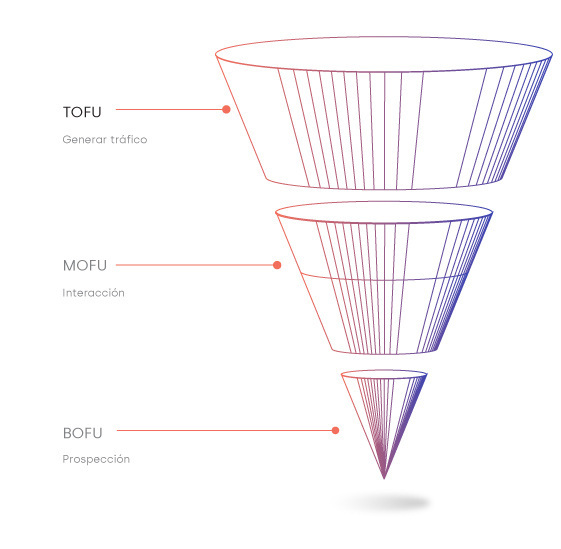
To achieve this successfully, design the flow that leads to an action based on the sales funnel.
The sales funnel is essentially made up of 3 parts:
- The top part: Top of the Funnel (TOFU)
- The middle part: Middle of the Funnel (MOFU)
- The bottom part: Bottom of the Funnel (BOFU)
In the first phase of the funnel, the TOFU or top of the funnel, we must generate awareness of your business.
Whether the visitor has arrived at your website as a result of a Google search, a social media ad, an advertising campaign, or the design of your site, it is time to attract the potential customer through content marketing.
This is done through continuous posts on a blog that provide visitors with valuable information that answers their searches.
At this point, it is important to demonstrate your business's expertise in the industry with quality articles and expert opinions, so visitors can recognize your company as a thought leader and trust the knowledge, products, and services you offer.
In our next video blog, we will talk about each part of the funnel and what actions we can take to improve each stage from our website and thus, close sales.
To learn about all the phases of the sales funnel on your website, follow us on our YouTube channel Brand Industry, our next video blog.